

Something We All Have…
“Let no debt remain outstanding, except the continuing debt to love one another, for whoever loves others has fulfilled the law. The commandments, “You shall not commit adultery,” “You shall not murder,” “You shall not steal,” “You shall not covet,” and whatever other command there may be, are summed up in this one command: “Love your neighbor as yourself.” Love does no harm to a neighbor. Therefore love is the fulfillment of the law.” (Romans 13:8-10, NIV)
First Corinthians 13 is certainly a wonderful description of love, but Paul wrote another “love chapter” in Romans 12 that actually extends about halfway into Romans 13. Today let’s look at the last segment of that exposition here in ROMANS 13. It is chock full of practical applications about love. The first seven verses in this Chapter 13 exhort Christians to respect authority and to obey those in authority over them, because love is not rebellious or selfish. He encourages us to “give everyone what you owe them”, whether it be financial, social, or spiritual. (Taxes, revenue, respect, honor…) Paul then pivots from paying taxes to handling debt, and intimates that we all have outstanding debts which have nothing to do with money in verse 8: “Let no debt remain outstanding, except the continuing debt to love one another, for whoever loves others has fulfilled the law.”
Who do you owe something to? Paul says we are to live as if we have a “continuing debt of love to one another.” Think for a moment about the people in your life; who are you indebted to? Is there anyone to whom you owe a heart-felt ‘thank you’, an apology, or a kind word? Is there anyone to whom you should express respect or honor? What is keeping you from completing that transaction? Paul then draws his logical progression of thought to a close with an important conclusion about love: it is debt-free.
Free From Debt
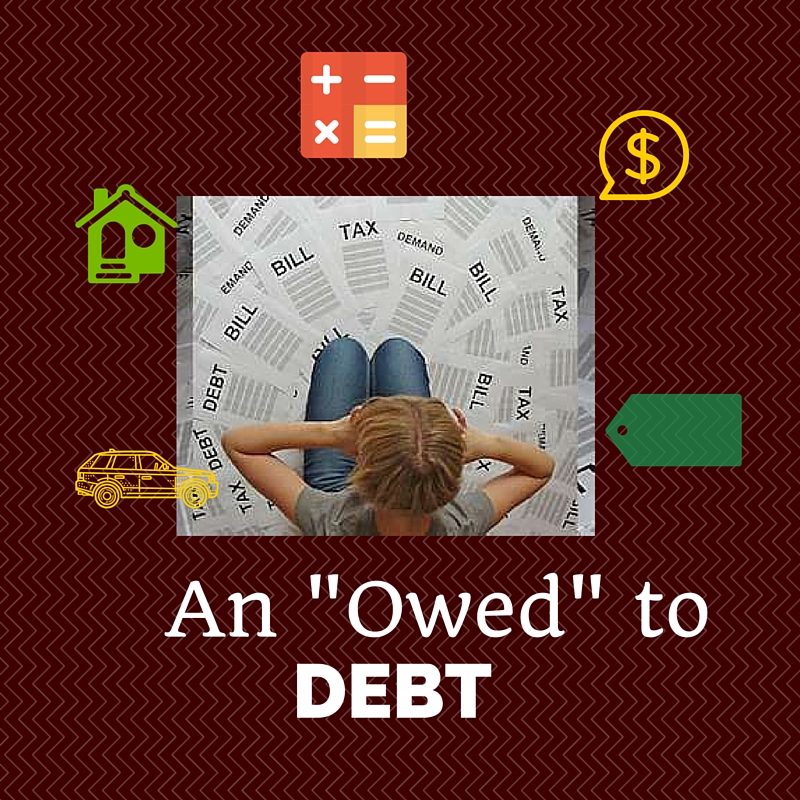
The law is based upon debt. When you break the law, you place yourself in its debt because you owe the law-maker a penalty for what you did. It is only by paying the penalty that you can atone for your transgression and obtain pardon. Ask yourself, why are we hard-wired to regret certain things, to feel guilt? As a child, I imagined God as a cosmic scorekeeper, writing down my every action with black checks or red marks on a ledger; I knew innately that doing wrong has a price, and I was worried that my (bad) red marks were far more numerous than my good ones.
We are hard-wired to understand good or evil, to feel guilt or remorse. The fundamental problem with sin and selfishness on a cosmic scale is that we accumulate more debt than we can repay, and we put ourselves into debt under the law. As the creator of the law, God’s righteousness requires payment for justice to be served. C.S. Lewis makes an excellent point about the existence of moral standards among men: “In fact, of course, we all do believe that some moralities are better than others. We do believe that some of the people who tried to change the moral ideals of their own age were what we would call Reformers or pioneers–people who understood morality better than their neighbors did. Very well then. The moment you say that one set of moral ideals can be better than another, you are in fact, measuring them both by a standard, saying that one of them conforms to that standard more nearly than the other. But the standard that measures two things is completely different from either. You are in fact, comparing them both with some Real Morality, admitting that there is such a thing as a real Right, independent of what people think, and that some people’s ideas get nearer to that real Right than others.” In Lewis’s summary, that “real Right” must be God.
But Not For Free…
The existence of Godly morality is the foundation for Paul’s argument about moral debt. “For the wages of sin is death; but the gift of God is eternal life through Jesus Christ our Lord.” (Romans 6:23) Love paid the debt, and Paul says the only way to keep from incurring further debt is to live in love. Once again he echoes the teachings of Jesus (how did he know so much about what Jesus taught without a printing press or even the internet?), who said, “Love the Lord your God with all your heart and with all your soul and with all your mind. This is the first and greatest commandment. And the second is like it: ‘Love your neighbor as yourself.’ All the Law and the Prophets hang on these two commandments.” (Matthew 22:37-39)
Love fulfills the law in several ways. It offers payment for the penalty of the law; it offers freedom in the presence of the law; and it prevents our falling further under the debilitating power of the law. Love clears the debt. It’s not money or stuff that enables you to live debt-free, it’s love alone. Go do something loving today. Send a word of encouragement. Mend an old fence. Say that ‘thank you’ to someone you once carelessly forgot to thank. Give a hug. Or just get down on your knees and remember who you were most indebted to, and who paid the debt.
Ode To Debt
Heaven: everyone wants in, But everyone is touched by sin; Remember, as you draw each breath, The wages for your sin are death. You owe a debt you cannot pay No matter what you do or say. In spite of all the plans you’ve made, You have a debt that must be paid. But God reached out to you, and me, And Jesus paid our penalty. The law, Paul says, is satisfied Where love is given and applied, As Jesus demonstrated To the world that He created. He superseded time and space, And offered us amazing grace: He paid our debt. He took our place.
To buy my latest book, Real People, Real Christmas: Thirty-one Days Discovering the Hidden Treasures of the Christmas Story, go here: https://www.amazon.com/gp/product/1729034918/ref=oh_aui_detailpage_o00_s00?ie=UTF8&psc=1
For Slaying Giants: Thirty Days with David, go here: https://www.amazon.com/Slaying-Giants-Thirty-Devotions-Ordinary/dp/172568327X/ref=sr_1_1?ie=UTF8&qid=1535814431&sr=8-1&keywords=Slaying+Giants%3A+Thirty+Days+With+David
To buy my book, Beggar’s Bread, go here: https://www.amazon.com/Beggars-Bread-Devotions-Ordinary-Guy/dp/1535457392/ref=sr_1_1?ie=UTF8&qid=1473336800&sr=8-1&keywords=Beggar%27s+Bread


